Got a minute?
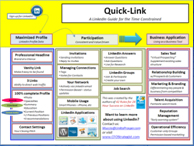
Get our FREE Quick-Link Guide…
Everything you want to know about LinkedIn… at a glance! !
Name :
Email :
 
   
25 May  2008 ~

Job Search 2.0 Given the uncertain economic times (rising oil prices, presidential election, credit crunch and housing crisis), do you know for sure if your job is going to be there in 6 or 12 months?  Since social media is about new ways of communication, and communication is the foundation for relationship building, do you where to begin to properly launch a relationship building campaign that could lead to your next position?
In this post, we will take a look at two things – the most effective social media tools that can support your job search and the tactics you would want to follow.

Most job searches today begin with a search of the online job boards.  Statistically speaking though, less than 10% of people searching for jobs that way, actually land them.  There are many reasons for that, which we can cover in another post.  Thus we need to be trying other avenues as well. Some of the traditional ones include; networking, looking through help wanted ads, working with professional outplacement firms, like DBM or Right Management, and working with headhunters to name a few.
Now its time to add social media to that list!  I would suggest leveraging sites like www.Linkedin.com, www.HubPages.com, www.Twitter.com, and www.YouTube.com.  Before we get into how we might utilize those sites, let’s prepare for what we are trying to achieve.  Take a few minutes and address the following items/questions:

  • What type of position am I looking for?
  • Determine which companies might offer what I am looking to pursue? Then, create a list of them
  • Research those companies, and as best as possible, determine their financial health.  If a company doesn’t pass your “sniff test”, meaning something doesn’t “smell right”, put those companies on a separate list and proceed with caution with those.

Once you’ve addressed the above comments, you are ready to begin your relationship building.  The goal is to look for ways to connect with hiring authorities within those companies.  So, how can social media help?
Warm Leads

The first place to go would be Linkedin (www.Linkedin.com) and determine if you have any warm contacts into those companies.  Next I would suggest the following tactics:

  • Using the list of companies that you’ve generated, search them on Linkedin (all 500 of the Fortune 500 are on Linkedin) and see which individuals show up in your search results
  • Split these individuals into two categories by looking through their profiles. Category #1 – would be a list of people that are currently working there and Category #2 – would be comprised of people that previously worked there.  Don’t get too crazy in terms of the size of your lists.  Keep them manageable and focused on key relationships , relative to your expertise
  • Sort these lists based on your tier 1 or 2 contacts
  • Next, research the profiles of your “best contacts” looking for key phrases on the type of work they do and jot these notes down about their specific job functions
  • Now – armed with a little “intel”, assuming you have a Linkedin network, try to contact who you consider the most relevant people to your search within those companies. The key point here is the warmer the contact the better. 

Cold Contacts
If you don’t have a large network, here’s some additional tips you could follow.

Let’s assume that you have identified a list of people on Linkedin, that seemed to be relevant to the type of position you’re looking for. …now look for ways to make contact with them in a non intrusive matter.

  • See if any of them are using the Linkedin Answers function – either asking or answering questions.  Either way, try to provide an answer to these questions. This may get their attention.
  • If not, read through their profiles and take another route – see who has recommended them and determine if there was any way for you to connect with the person doing the recommending via Linkedin Answers or otherwise.  If so, that could provide you a solid entrée to your “cold contact”
  • Also – see if your cold contact participates in any of the Linkedin Groups. If they do, try to join that group and try to establish contact that way.

Next, I would suggest using www.Twitter.com

  • Perform some searches on the names of the people you are interested in connecting with. If they are on Twitter, follow them. Many times the people you follow, in turn also begin to follow you. This would be a great way for your name, your picture and your comments to flow in an unobtrusive, yet constant manner in front of them. 
  • If they’re not on Twitter, you may still want to run your communications on that site as if those people were on and were following you. You never know when someone may find you. You may looking for one person yet another, similar one finds you instead.

Attention

The goal here would be to exhibit your knowledge & expertise. Here are 5 ideas to get you started on this.

  1. Create your own blog. Focus solely on the topic that that you are looking to demonstrate your expertise in. 
  2. Similarly, utilize www.HubPages.com and create hubs that highlight your knowledge of a particular topic. For instance, let’s say you’re an expert in HR. I would suggest creating one hub every 2 weeks around a particularly interesting HR topic.  Expect to put in 1-2 hours per well constructed hub.
  3. Leverage the power of video. My suggestion… create a series of short PowerPoint presentations, no more than two slides and lasting no more than one minute of speech. Then convert that into a video. At the end of the video offer a slide that provides information on how to get in touch with you or learn more about you. Again the videos need to be on a topic of relevance to your expertise and make sure they are no longer than three minutes each.
  4. Update your email signature so an interested recipient can learn more about you.  For instance, your current signature already has your e-mail address and phone number.  Now add the URL for your blog, your Twitter contact info and also a link to your Linkedin profile.
  5. Lastly, identify at least five websites in which you can participate in, and provide comments. Benefit here is to exhibit your expertise and in turn, passively offer a link to your social media contact points. 

So as we wrap up his post, I would leave you with four things that you could start now.

  1. If you don’t have an account at twitter.com, open one.  It takes two minutes and it’s free. For free resources on twitter.com, you can check out www.imarket20/Twitter
  2. Go to Google and sign up for a free Blogger account
  3. If you are not on Linkedin, go ahead and start the registration process. To do this correctly, allocate yourself an hour or two to make sure your profile is most effectively developed.
  4. Open your own HubPages account. Perform a couple of searches to learn how people most effectively set up their hubs.  Use that as a guide for your hub creation.

If you follow these four steps, within three hours you’ll have your communication infrastructure set in place.  Now it’s up to you to execute on it!

There are many other sites that you could bring to bear on your behalf – feel free to offer your thoughts on what has worked for you.

Technorati , , , ,
Share and Enjoy:
  • Digg
  • del.icio.us
  • Netvouz
  • DZone
  • ThisNext
  • Wists
  • StumbleUpon
  • Technorati
If you enjoyed this post, make sure you subscribe to my RSS feed!

If you want to be notified the next time I write something, subscribe to my RSS feed. Thanks for reading.


No Comments »

Leave a comment